


TL;DR / Key Takeaways
- Fundamental Boundary: A LAN interconnects devices within a limited physical area to enable high-speed data exchange and resource sharing.
- High Performance: Local networks deliver sub-millisecond latencies and transfer speeds reaching up to 10 Gbps and beyond.
- Security Control: Isolating internal traffic inside a local perimeter simplifies access policies, threat monitoring, and device management.
Every time you send a file to an office printer or stream video to a Smart TV, your data bypasses the public internet entirely. Local network architecture handles the heavy lifting of private data transport, isolating internal traffic for maximum speed and security.
Whether managing enterprise office infrastructure or optimizing a multi-device home network, understanding local networking fundamentals is essential.
What Is a LAN and How Does It Function?
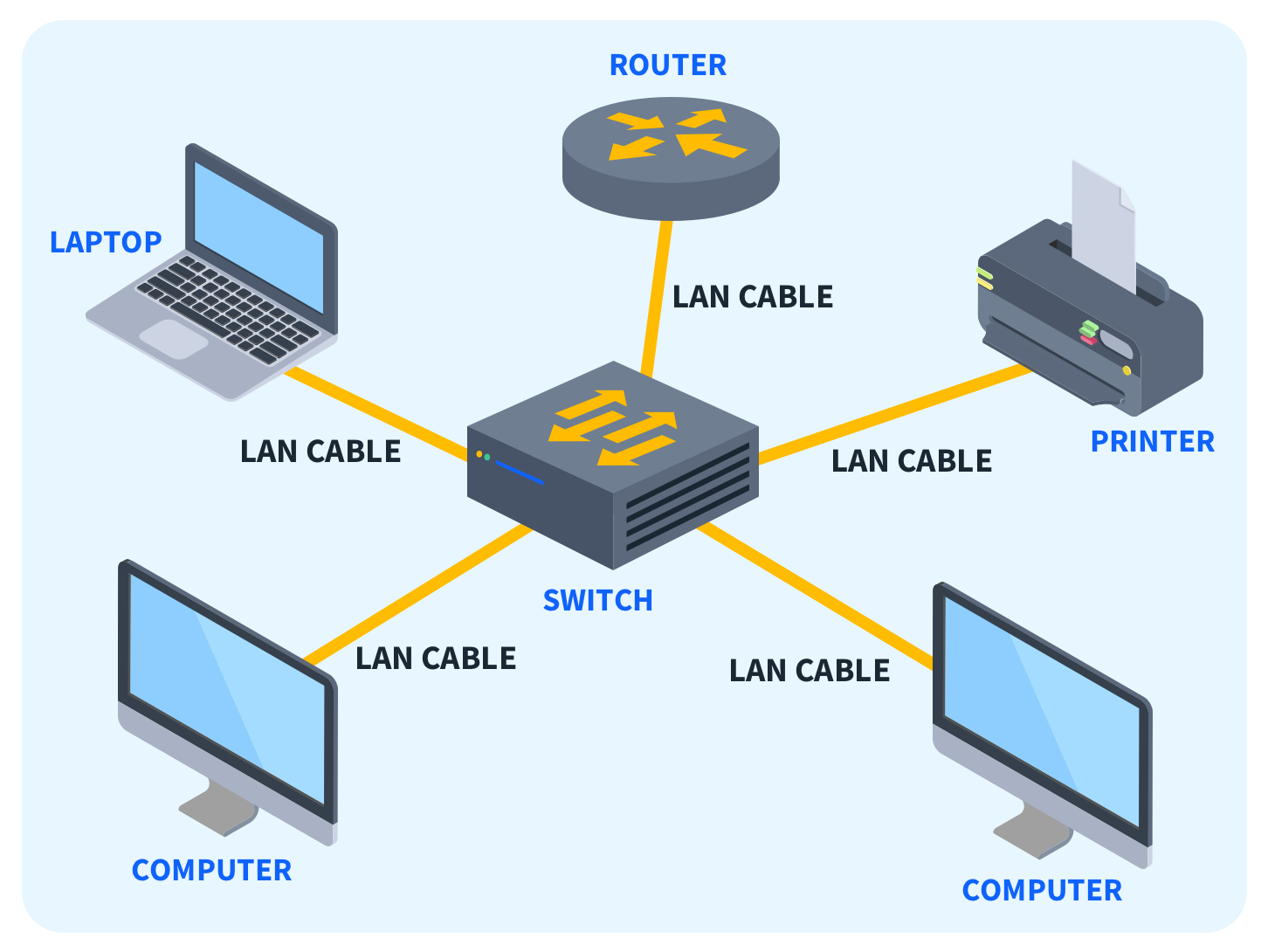
A local network connects workstations, servers, printers, and IoT devices within a single room, home, building, or close group of structures. It provides a shared physical and logical platform for endpoints to communicate without sending traffic over external provider networks.
When two local devices exchange packets, an Ethernet switch reads the data link destination address and routes the signal directly to the target device. This local routing mechanism avoids wide-area network bottlenecks and maintains data transfer rates of 1 Gbps to 10 Gbps.
In foundational network architecture, the full form of LAN is Local Area Network, which describes a privately managed system bound by geographical proximity.
Key Architectural Components of a Modern LAN
A robust local network relies on specialized hardware layers to maintain reliable, low-latency connectivity across all connected endpoints.
Ethernet Switches and Network Interface Cards
Ethernet switches form the core backbone of a wired network by directing layer-2 data frames directly between connected devices.
Every device on the network connects via its internal Network Interface Card (NIC), which provides a unique physical MAC address for local destination routing.
Wireless Access Points (WAPs) and Routers
Wireless Access Points extend local network coverage by translating wired Ethernet frames into radio signals for mobile devices.
The local gateway router sits at the perimeter of the network, translating internal addresses and directing outbound traffic toward external wide-area networks.
| Component | Network Layer | Primary Function |
| Ethernet Switch | Layer 2 (Data Link) | Connects local endpoints and forwards frames via MAC addresses. |
| Gateway Router | Layer 3 (Network) | Connects local private subnets to external public networks. |
| Wireless Access Point | Layer 1 & 2 | Extends local connectivity via Wi-Fi radio frequencies. |
| Category Cable (Cat6a) | Layer 1 (Physical) | Carries physical electrical/optical signals up to 10 Gbps speeds. |
Why LAN Infrastructure Matters in Telecommunications
Local networks act as the critical final link in global telecommunications pipelines, directly influencing end-user performance and security.
Latency Reduction and Traffic Offloading
Local network setups keep local data traffic—such as intra-office file shares and local media streaming—off external internet pipes.
- Sub-Millisecond Ping: Direct device-to-device communication occurs with minimal latency.
- Bandwidth Savings: Internal data exchanges consume zero external ISP data allowance.
- High Throughput: Local transfers are bounded only by local switch capacity, not internet package caps.
Enhanced Network Security and Access Isolation
By keeping internal assets on a private subnet, administrators can enforce strict access control policies and firewall boundaries.
Isolating sensitive infrastructure—like internal database servers or corporate storage units—within a local network prevents direct exposure to external cyber threats.
Frequently Asked Questions (FAQ)
What is the primary difference between a LAN and a WAN?
A local network covers a restricted geographic space like an office or home, whereas a wide-area network (WAN) spans multiple cities, countries, or global regions.
Can a local network operate without an active internet connection?
Yes, devices on a local network can share files, print documents, and stream local media even if the external internet connection drops completely.
What is the difference between a wired LAN and a WLAN?
A wired setup uses physical Ethernet cabling to connect devices, while a WLAN (Wireless Local Area Network) uses Wi-Fi radio frequencies to connect endpoints wirelessly.
Conclusion
Local networking architecture serves as the foundation for modern private computing environments. By delivering high-speed data transmission, minimal latency, and centralized security management, local networks remain an essential component of telecommunications and IT infrastructure.




0 Comments